Touching the Virtual Patient: Wearable Haptics for Immersive Surgical Training
Introduction
Hands-on experience is fundamental in surgical education. Traditionally, surgeons acquire practical skills through observation and supervised practice in real operating rooms. While effective, this apprenticeship-based model presents several limitations. Opportunities for training are constrained by the availability of surgical cases, ethical considerations, and the need to ensure patient safety.
Virtual Reality (VR) has emerged as a powerful tool to address these challenges by enabling trainees to practice procedures in controlled and repeatable environments. VR simulations allow students to rehearse surgical procedures multiple times, explore different clinical scenarios, and learn from mistakes without compromising patient safety.
However, visual immersion alone cannot fully reproduce surgical interactions. Surgery relies heavily on tactile perception. Surgeons constantly interpret forces, tissue resistance, and tool interactions through the sense of touch. Without tactile feedback, simulated environments remain limited in their ability to reproduce realistic surgical experiences.
To address this limitation, researchers have increasingly integrated haptic technologies into virtual training systems. Haptic feedback introduces the sense of touch into virtual environments by reproducing tactile sensations such as forces, vibrations, textures, and temperature changes. This additional sensory channel significantly enhances realism and supports the development of motor skills required in surgical practice.
Recent advances in wearable haptic interfaces have opened new possibilities for immersive medical training. Unlike traditional grounded force-feedback devices, wearable systems such as gloves or fingertip interfaces allow users to move freely while interacting with virtual objects. These interfaces can deliver multimodal tactile cues directly to the user’s skin, enabling more natural interaction with simulated surgical environments.
Haptic Feedback in Surgical Training
Haptic feedback can play two important roles in surgical training simulations.
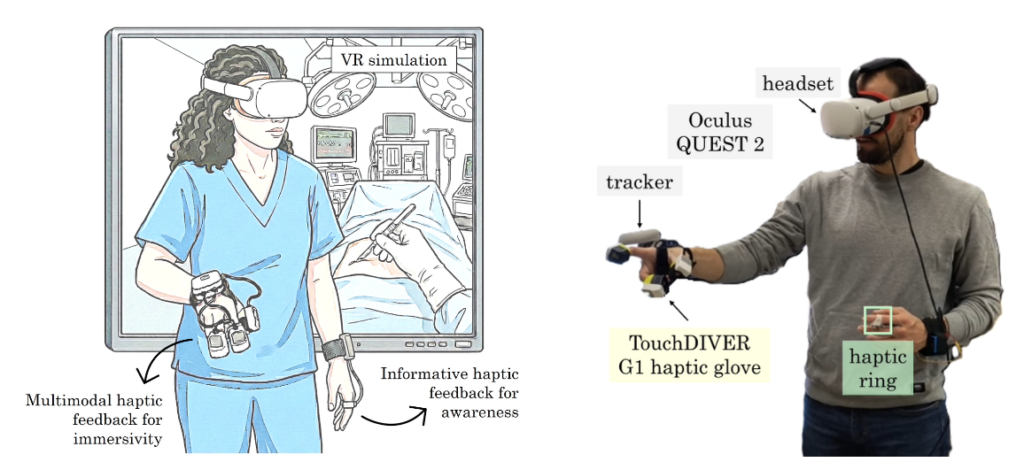
First, it enhances immersion. By reproducing tactile sensations associated with tool–tissue interaction, haptic devices help create realistic learning environments where trainees can develop motor skills and procedural understanding.
Second, haptic cues can provide informative feedback during training. For example, tactile signals such as vibrations can indicate the completion of procedural steps, warn users about incorrect actions, or guide the trainee through a sequence of surgical tasks.
These two complementary roles—immersive feedback and informative feedback—can significantly improve user awareness and performance during simulated procedures.
Figure 1
Wearable haptic feedback integrated in a VR surgical training environment. On the left. Concept: augmenting VR-based surgical training with haptic feedback for immersivity and awareness. On the right. Setup adopted in [1]: feedback for immersivity is given by a glove delivering multimodal tactile cues (contact, texture, temperature), whereas a vibrotactile ring gives informative feedback.
Wearable Haptic Interfaces
Wearable haptic technologies represent a promising direction for surgical education because they combine portability, flexibility, and multimodal feedback capabilities.
Unlike traditional grounded haptic devices, wearable interfaces can be integrated into gloves or fingertip modules. This allows trainees to interact naturally with virtual environments while receiving tactile cues directly on their skin.
These devices can deliver different types of stimuli including:
- contact forces
- surface textures
- vibrotactile feedback
- thermal cues
When combined with VR environments, wearable haptic devices allow trainees to interact naturally with virtual tools and anatomical structures, improving both immersion and learning effectiveness.
Applications of Haptics in Surgical Training
Haptic technologies can support several types of surgical training activities.
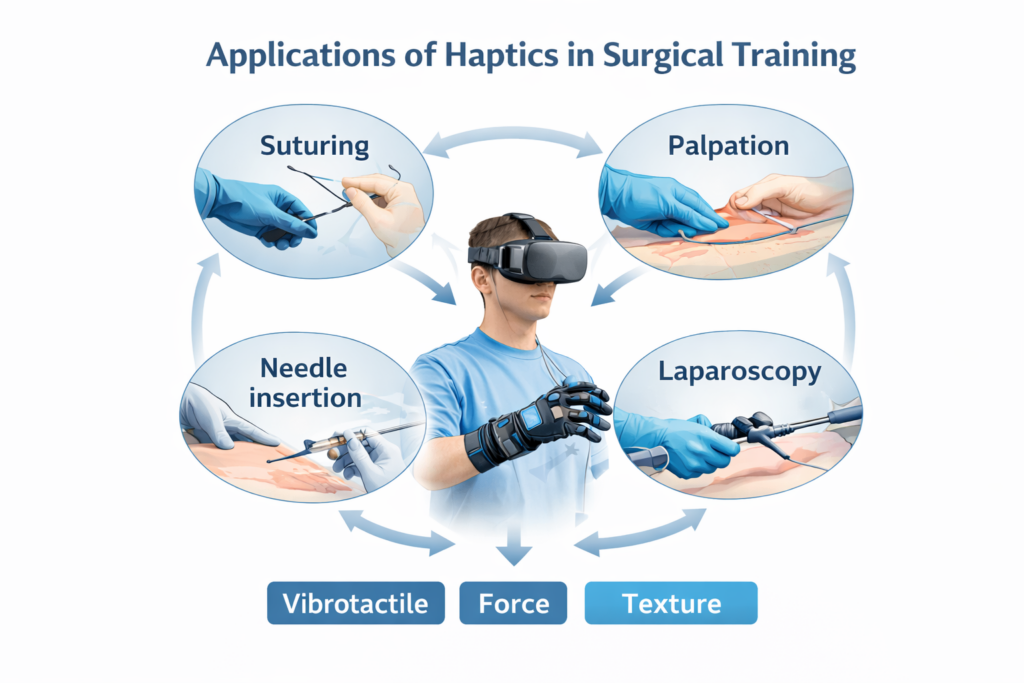
One important application is training basic surgical gestures, such as suturing, needle insertion, and instrument manipulation. Haptic feedback helps trainees develop precise force control and hand–eye coordination.
Another application involves palpation and tissue exploration. In many medical procedures, clinicians rely on tactile perception to identify abnormalities such as tumors or tissue stiffness. Haptic simulations allow students to practice these diagnostic skills in a safe and controlled environment.
Haptic interfaces can also support procedure guidance. Tactile signals can indicate errors, guide movements, or notify trainees when a step of a surgical procedure has been completed.
Finally, immersive simulations combining VR and wearable haptics can enable interactive rehearsal of complete procedures, allowing trainees to practice complex workflows before entering the operating room.
Figure 2
Conceptual overview of possible applications of haptics in surgical training.
Conclusion
Haptic technologies represent an important step toward more immersive and effective medical education. By restoring the sense of touch in simulated environments, haptic interfaces help bridge the gap between theoretical learning and practical surgical training.
Wearable haptic devices, in particular, offer a flexible and scalable solution for integrating tactile feedback into VR-based simulations. By combining visual immersion with tactile interaction, these systems can improve training realism and support the development of essential surgical skills.
As immersive technologies continue to evolve, the integration of haptics into medical simulation platforms is expected to play a key role in the future of surgical education.
References:
[1] Wearable Haptic Feedback for Immersivity and User Awareness in VR-based Surgical Training, submitted to Eurohaptics 2026